
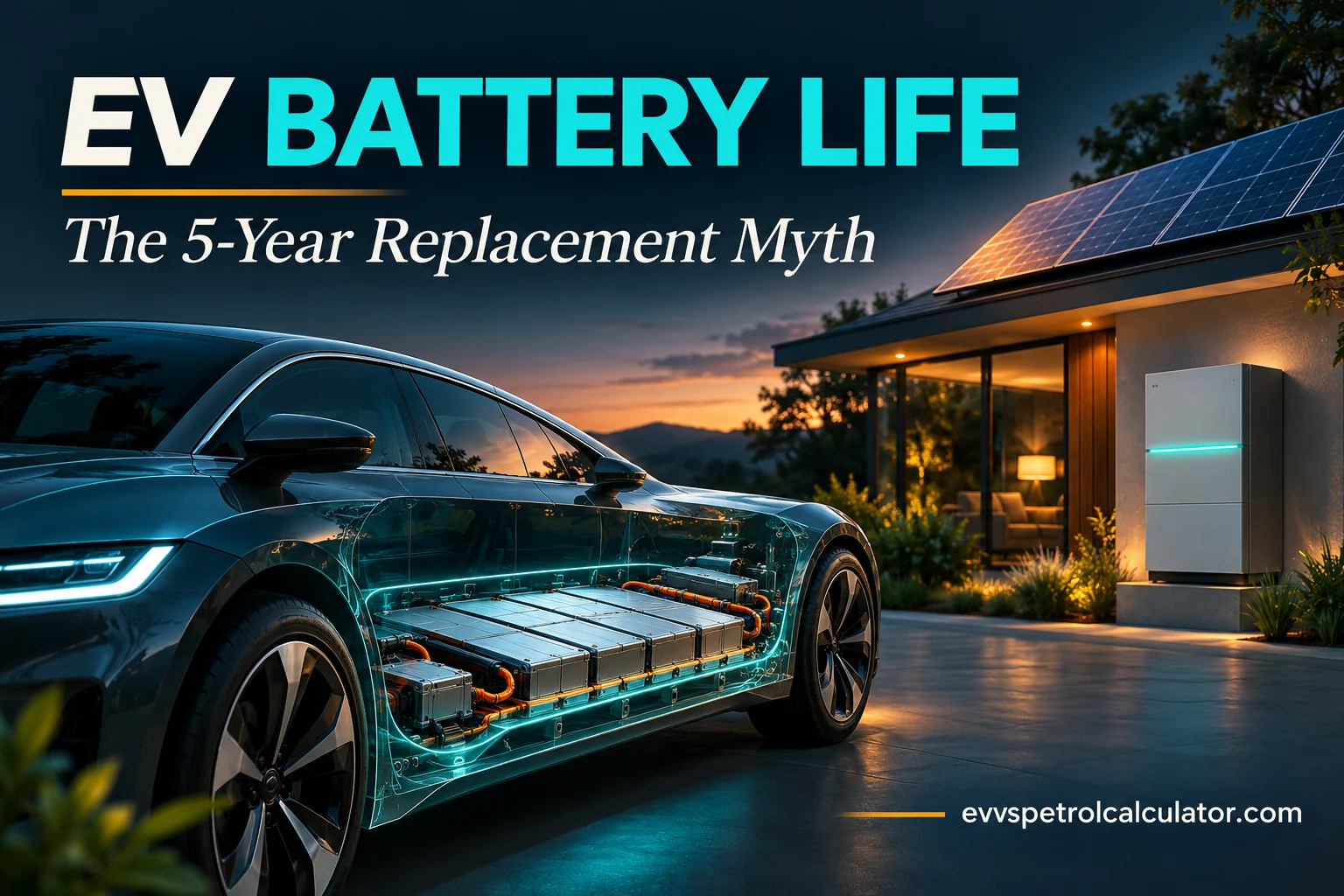
The expensive part of a used electric car is easy to imagine: a battery warning, a workshop visit and a bill that wipes out years of fuel savings. That possibility deserves a proper check. It doesn’t justify assuming that every EV needs a new battery on its fifth birthday.
The EV battery replacement cost myth vs reality comes down to three different questions. How much usable capacity has the battery lost? Is there a fault that needs repair? And does the remaining range still cover your journeys? Those questions can have very different answers in the same car.
A battery with reduced capacity can remain useful for years. A relatively young pack can also develop a fault. Age alone tells you neither the repair bill nor whether replacement is necessary. For a used buyer, a documented battery assessment is more useful than a confident promise about how long all batteries last.
For the other service items in your budget, compare EV and petrol maintenance costs. To test a conservative resale assumption, use the five-year ownership benchmark.
1. The core dilemma: battery wear is not a replacement schedule
Your phone offers an imperfect analogy. It can lose some runtime while continuing to work, but an EV has a much larger pack, different controls and, in many designs, active temperature management. You shouldn’t predict a car’s life from your experience with a handset.
Battery degradation is the gradual reduction in usable energy storage. Failure is a fault that prevents safe or satisfactory operation. Warranty coverage is a contractual question. None of these is interchangeable with the others.
State of health, usually shortened to SOH, compares the battery’s current capacity with a reference capacity when new. Check how the figure was obtained: a dashboard estimate, a diagnostic report and a controlled usable-energy test don’t necessarily measure exactly the same thing. Temperature, software and recent charging history can affect readings.
Imagine a car that originally offered 350 km under conditions similar to yours. At 85% usable capacity, a simple proportional estimate suggests about 298 km under those same conditions. That is an illustration, not a range forecast. Speed, heating, tyres, weather and the manufacturer’s usable buffer still matter. Yet it shows why losing capacity does not automatically make a battery unusable.
The right question is whether your reliable winter range, including a sensible arrival reserve, remains sufficient. A buyer with a 35 km commute faces a different decision from someone who regularly needs 250 km between dependable chargers.
What does current degradation evidence actually show?
Geotab’s January 2026 analysis covered more than 22,700 EVs across 21 makes and models and reported average annual degradation of 2.3%. Its findings also associated heavier high-power DC charging with faster degradation. Those are fleet-level observations, not a diagnosis for an individual used car. Geotab’s published study announcement
The average changed from the company’s earlier analysis, which is another reason to avoid treating one percentage as a universal law. Vehicle mix, use patterns and the observation period affect a fleet result. A ten-year straight-line projection also hides the fact that real degradation need not be linear.
We therefore shouldn’t turn “88% capacity at 250,000 km” into a promise for every modern EV. Some vehicles perform well at high mileage; others have different histories, chemistry, thermal management or defects. Nor does the available evidence establish that every liquid-cooled battery will outlast its chassis or a petrol transmission.
The inspection that matters before purchase
Ask for the vehicle identification number, service history, recall completion and the exact battery warranty applicable to that car. Check whether coverage transfers to a subsequent owner and what evidence is required for a capacity claim. Get the terms in writing for your market and purchase date.
Then obtain an independent inspection from someone qualified to assess that model. A useful report identifies the test method, current faults, charging behaviour during the test and any limitations. It should help you distinguish capacity loss from a repairable component problem.
An unexplained warning light is not a bargaining opportunity until you understand the repair. Equally, a seller’s “battery health 100%” screenshot is not sufficient evidence that an older car has no risk. Compare the report with the actual route you need to drive.
2. Comparative savings: include risk without inventing a replacement bill
Start with energy spending. Suppose a petrol car uses 7 L/100 km and petrol costs $1.80/L. Its fuel bill is $12.60 per 100 km. An EV consuming 17 kWh/100 km at the battery, with 90% charging efficiency and electricity at $0.20/kWh, costs about $3.78 per 100 km at the meter.
At 15,000 km annually, that illustrative energy difference is approximately $1,323 a year. Public charging at $0.60/kWh changes the EV figure to $11.33 per 100 km and cuts the annual energy saving to about $190. The same battery can sit inside two very different ownership budgets.
These examples use dollars as a consistent illustration, not a live tariff for a particular country. Replace every price with local figures, include charging fees, and compare real-world consumption on similar journeys. Do not compare a petrol motorway figure with an EV’s best city result.
Scheduled maintenance and unexpected repair are different lines
An all-electric car avoids combustion-engine oil changes and spark plugs, but still has tyres, brakes, suspension, filters and model-specific checks. Cooling systems can need attention too. The US Department of Energy maintenance guide describes the broad differences; your service schedule determines what applies to your vehicle.
Routine maintenance savings cannot establish the probability of an expensive battery repair. Keep scheduled service estimates separate from an allowance for unexpected repairs. If you mix the two, it becomes difficult to understand why one scenario looks cheaper.
A quoted $15,000 replacement may be relevant to one car and repair route. It is not a standard annual charge for all EV owners. Ask whether a diagnosis points to a whole pack, a module, a contactor, cooling equipment or another component, and whether an approved repair or remanufactured option exists.
Also check labour, tax, transport, diagnostic charges and replacement warranty. A headline pack price can omit a large part of the final bill. Conversely, assuming the most expensive possible failure in every ownership calculation overstates expected cost.
Stress-test the purchase rather than guessing certainty
Run a base case with actual purchase prices, realistic resale estimates and scheduled costs. Then add a separate repair contingency outside the calculator. Compare what happens if you keep the car two years longer, sell it for less, or pay more for charging.
For example, adding a hypothetical $3,000 repair allowance to a five-year budget increases its average cost by $600 per year. This is a sensitivity test, not an assertion that the repair will happen. It helps you see whether the purchase still fits your finances when the optimistic case fails.
If an unexpected repair would make the car unaffordable, the right response may be stronger warranty coverage, a lower purchase price or a different vehicle. Lower fuel spending doesn’t remove the need for a cash buffer.
3. Environmental impact: second life is possible, not automatic
An EV has no exhaust CO2 while driving, but generating its electricity and manufacturing the vehicle create emissions. Battery manufacture is part of that footprint. A fair lifecycle comparison includes both vehicles’ production, their energy supply and their use over a comparable life.
Carbon payback occurs when lower operating emissions offset the EV’s additional manufacturing emissions relative to the chosen petrol car. It is not the same as financial payback. A clean grid, efficient vehicle and substantial mileage can shorten it; a large battery and carbon-intensive charging can lengthen it.
Use consistent boundaries. Comparing petrol tailpipe CO2 with the full lifecycle of an EV makes the petrol side incomplete. Comparing an EV’s zero tailpipe emissions with petrol’s fuel-cycle emissions makes the EV side incomplete. Our lifecycle emissions guide explains the distinction.
What second-life EV battery storage means
A battery that no longer suits an automotive application may still store energy for a building or stationary installation. Weight and packaging can matter less there. However, it needs testing, safe integration, suitable controls and an economic case against new storage equipment.
Second life isn’t a promise that every retired pack gets another 10–15 years. Research has modelled long secondary service under specified conditions, including daily peak-shaving applications, but useful life depends on initial health, duty cycle and operating conditions. NREL second-use research
The project must also cover collection, transport, testing, disassembly where required, certification, installation and future responsibility for the equipment. Those steps can determine whether reuse makes sense even when a battery still holds useful energy.
For a private car buyer, possible second-life value is not guaranteed resale income. Unless a firm buyer has offered a documented price, don’t subtract a speculative storage value from your ownership cost. A potential environmental benefit and a cash payment to the owner are different things.
Recycling percentages need a named material and process
Recycling can recover valuable battery materials, but “95% recycled” is incomplete without explaining what is measured. A process may recover a high proportion of selected metals while other materials follow different routes. Collection rates and actual recovery across a whole pack are separate questions.
Hydrometallurgical processing is one recycling approach, not proof that every retired battery achieves an identical outcome. Check the recycler, chemistry and stated recovery boundary before repeating a percentage. Reuse also does not remove the eventual need for responsible treatment.
4. Try the battery-health scenario and ownership calculator
Use the estimator below to explore a ten-year capacity scenario. The charging-frequency selector suggests an illustrative annual loss assumption; it does not predict your car’s health. You can edit that assumption. The model applies the same percentage-point loss each year and should be read as a sensitivity exercise, not a warranty or a validated battery-life forecast.
Ten-year battery capacity scenario
Scenario rates are illustrative, informed by fleet observations. Frequency alone cannot predict degradation. Linear percentage-point model; not a battery diagnosis.
Notice what changing the annual loss does to remaining capacity and approximate range. Then compare the year-ten range with your longest regular journey, including weather and reserve. If the result falls short, investigate charging access and the vehicle’s measured health rather than assuming an automatic replacement date.
Next open the EV vs petrol calculator. Enter both purchase prices, your monthly distance and realistic energy consumption. Choose local charging tariffs and your actual home/public share. Open each vehicle’s maintenance, insurance and depreciation settings and replace the examples.
The operating payback result uses the purchase-price premium divided by annual operating savings. The ownership chart also includes depreciation, so its crossover can differ. Neither automatically prices a battery replacement or predicts degradation. Keep any repair contingency alongside the result in your own budget.
For a used EV, test a conservative resale value and a public-charging-heavy case. Those often reveal more about affordability than arguing over a universal battery lifespan. See our break-even guide for the formula and its limits.
A useful check after your first estimate
Write down which figures came from evidence and which you supplied as assumptions. A workshop battery report, an insurance quote and an electricity bill carry different weight from a guessed resale value. Keep the date beside each one so you can update the comparison when circumstances change.
If the purchase only works with the highest possible resale price and the lowest possible charging rate, the margin is fragile. Try reducing resale and increasing energy prices together. That combined stress test is often closer to the uncertainty a used buyer faces than changing one input at a time. Discuss any battery concerns with a qualified technician before relying on the estimate to make a purchase.
5. Final recommendation matrix
| Your situation | What to check | Practical decision |
|---|---|---|
| Short commute, verified healthy pack | Winter range and accessible charging | Moderate capacity loss may be acceptable. |
| Frequent long trips | Reliable route range and charging speed | Test the journey before committing. |
| Missing history or battery warnings | Independent diagnosis and repair quote | Resolve uncertainty before paying. |
| Tight repair budget | Warranty terms and emergency funds | Choose a purchase that leaves financial room. |
| High public-charging dependence | Full delivered charging cost | Recalculate fuel savings conservatively. |
There is no general five-year replacement rule. There is also no substitute for checking the particular car. Buy the usable range, condition, warranty and ownership budget that you can verify today, rather than either a frightening worst-case bill or an unsupported lifetime guarantee.
Ready to test your commute? Run your personalized numbers at evvspetrolcalculator.com.
Enable JavaScript to compare your ownership estimates.